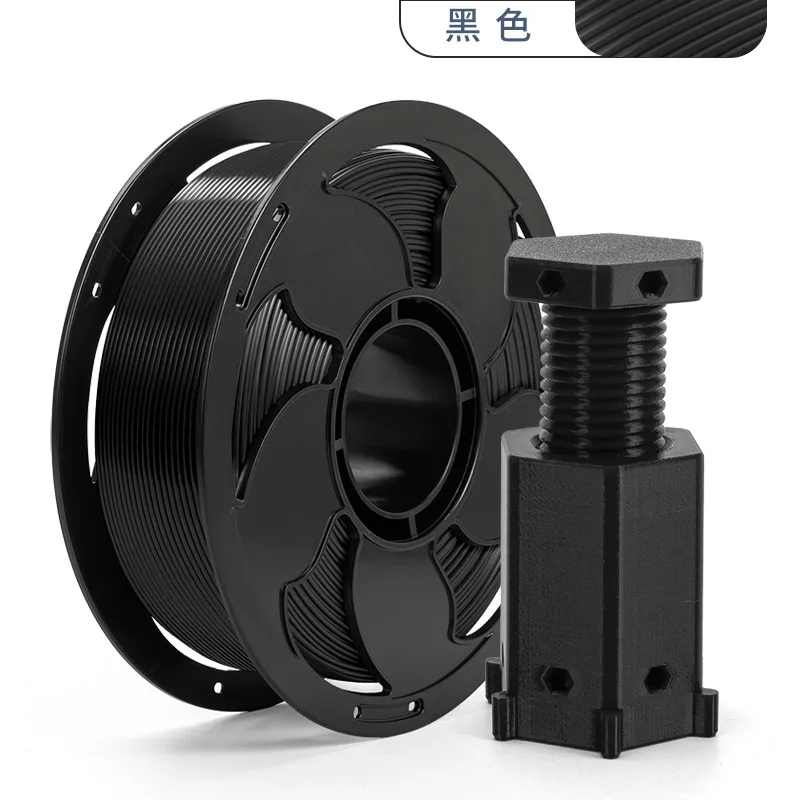
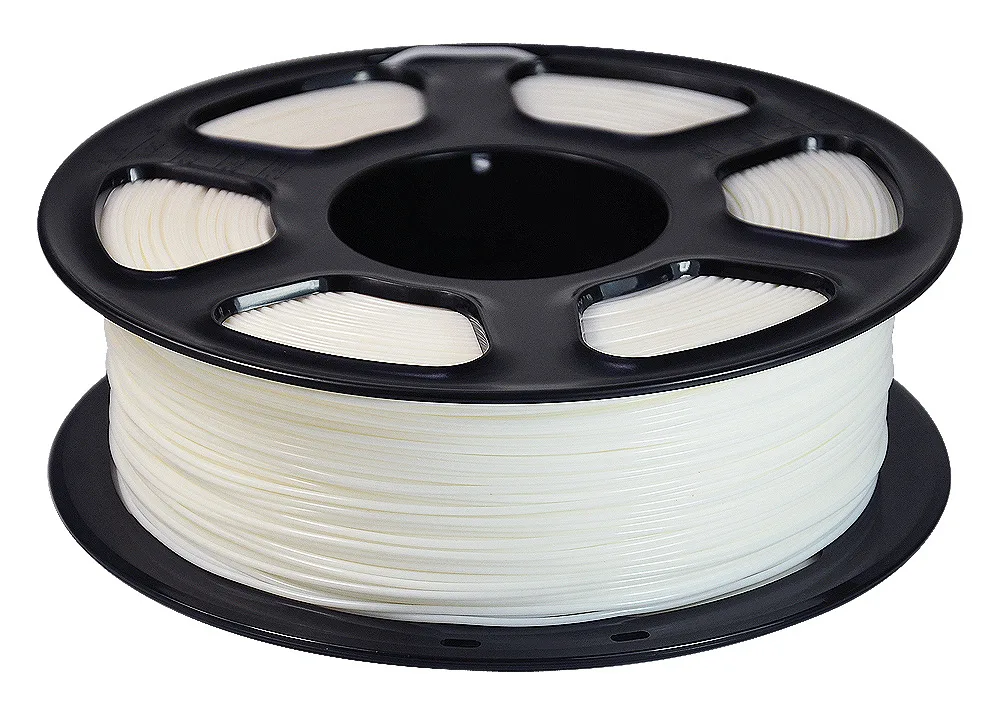
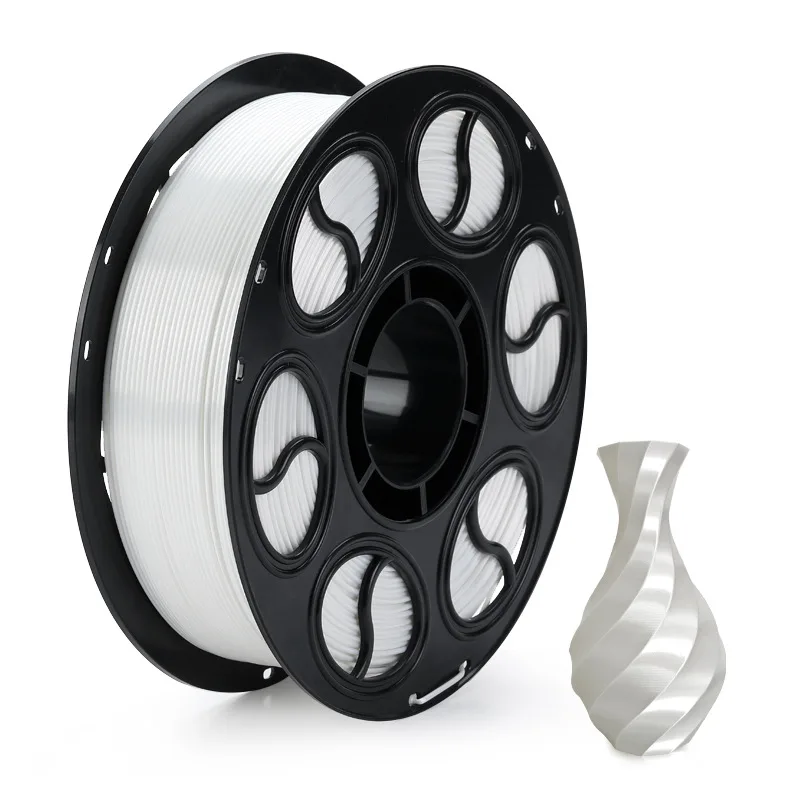
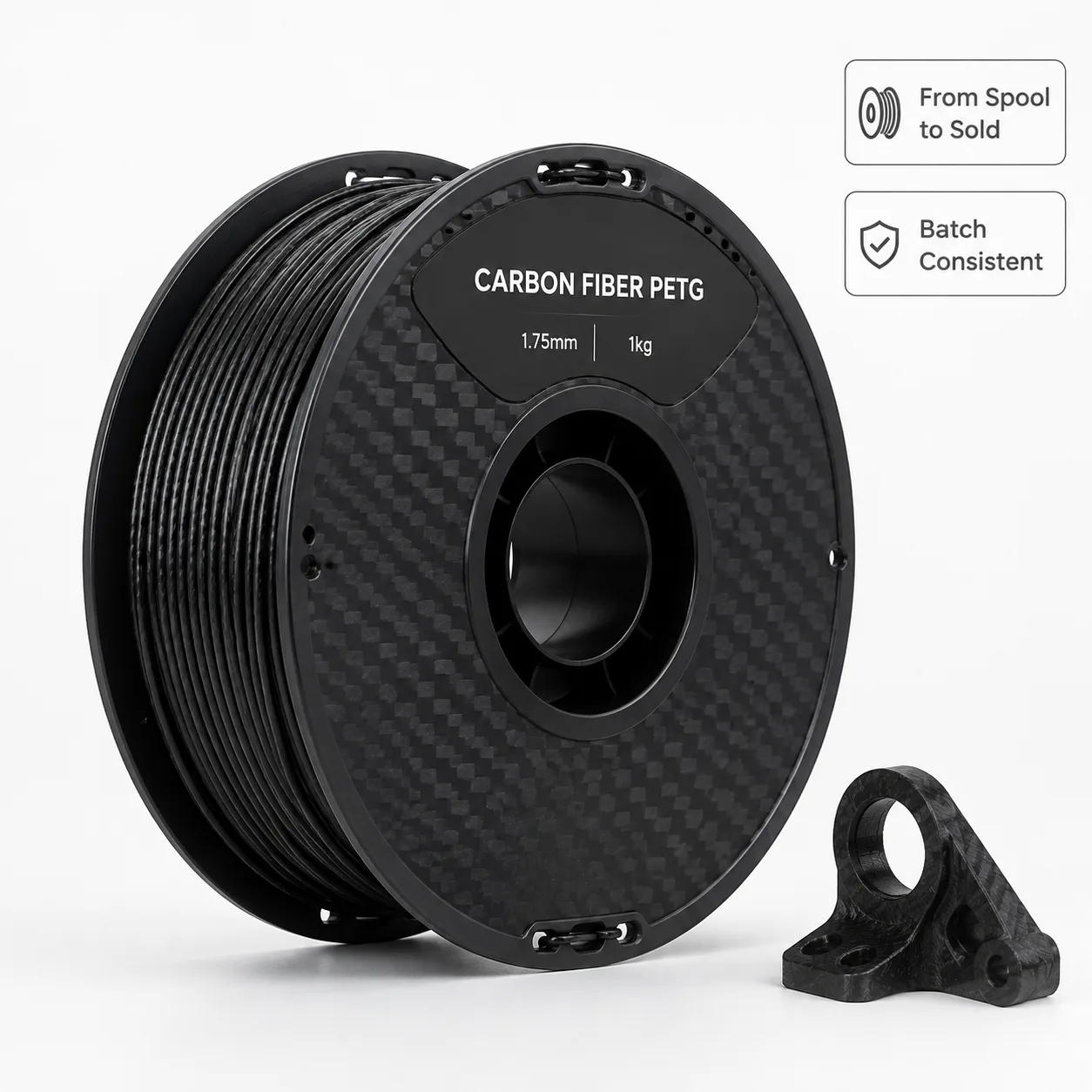
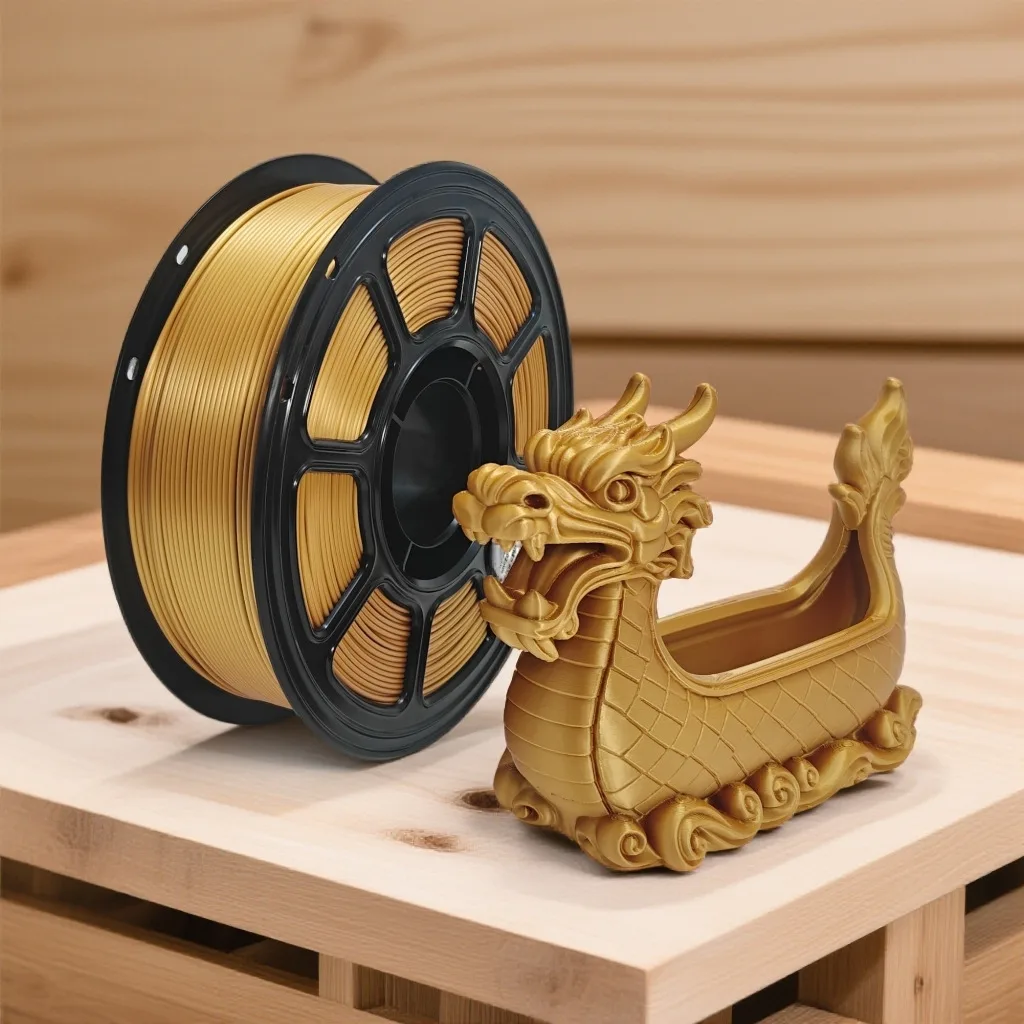


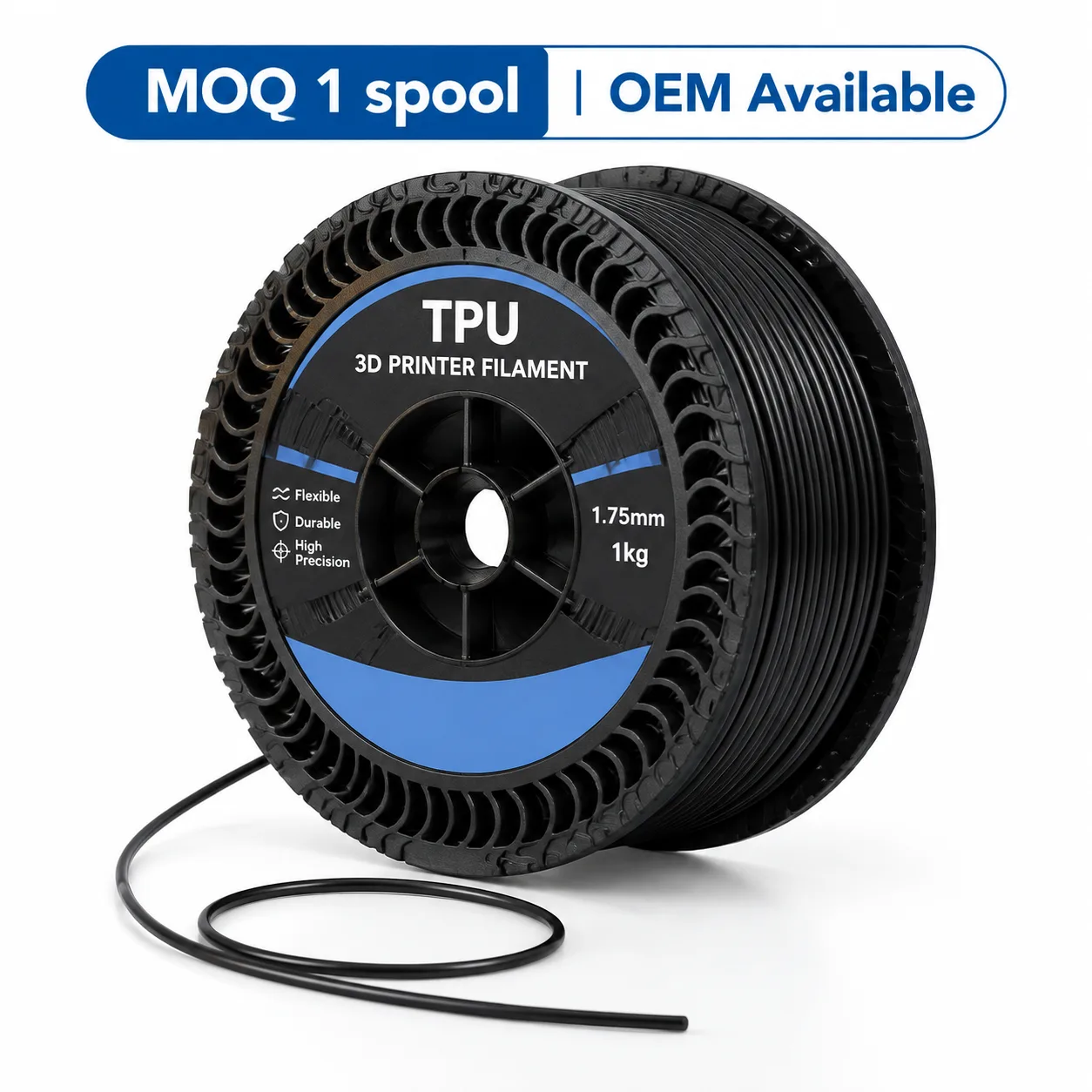
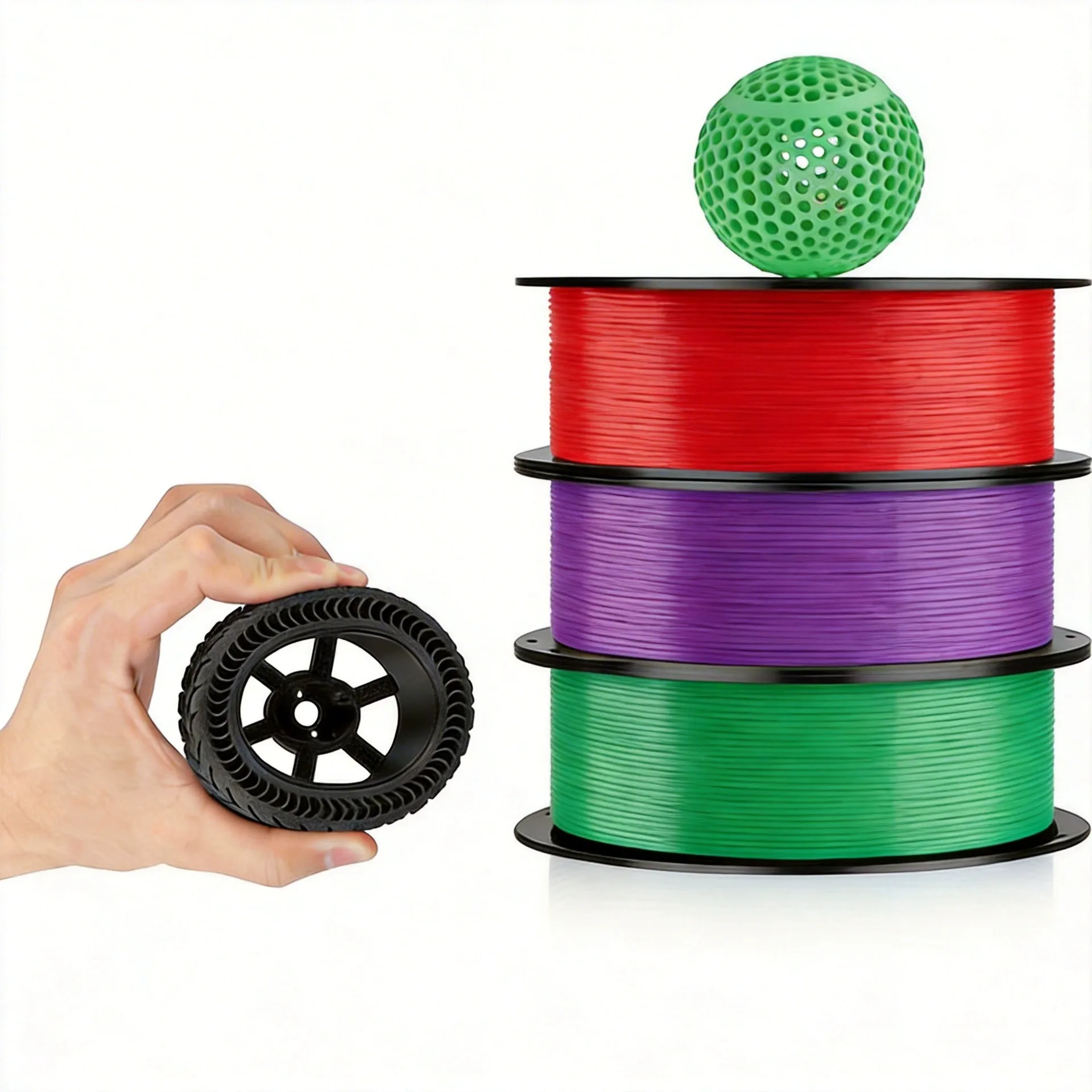
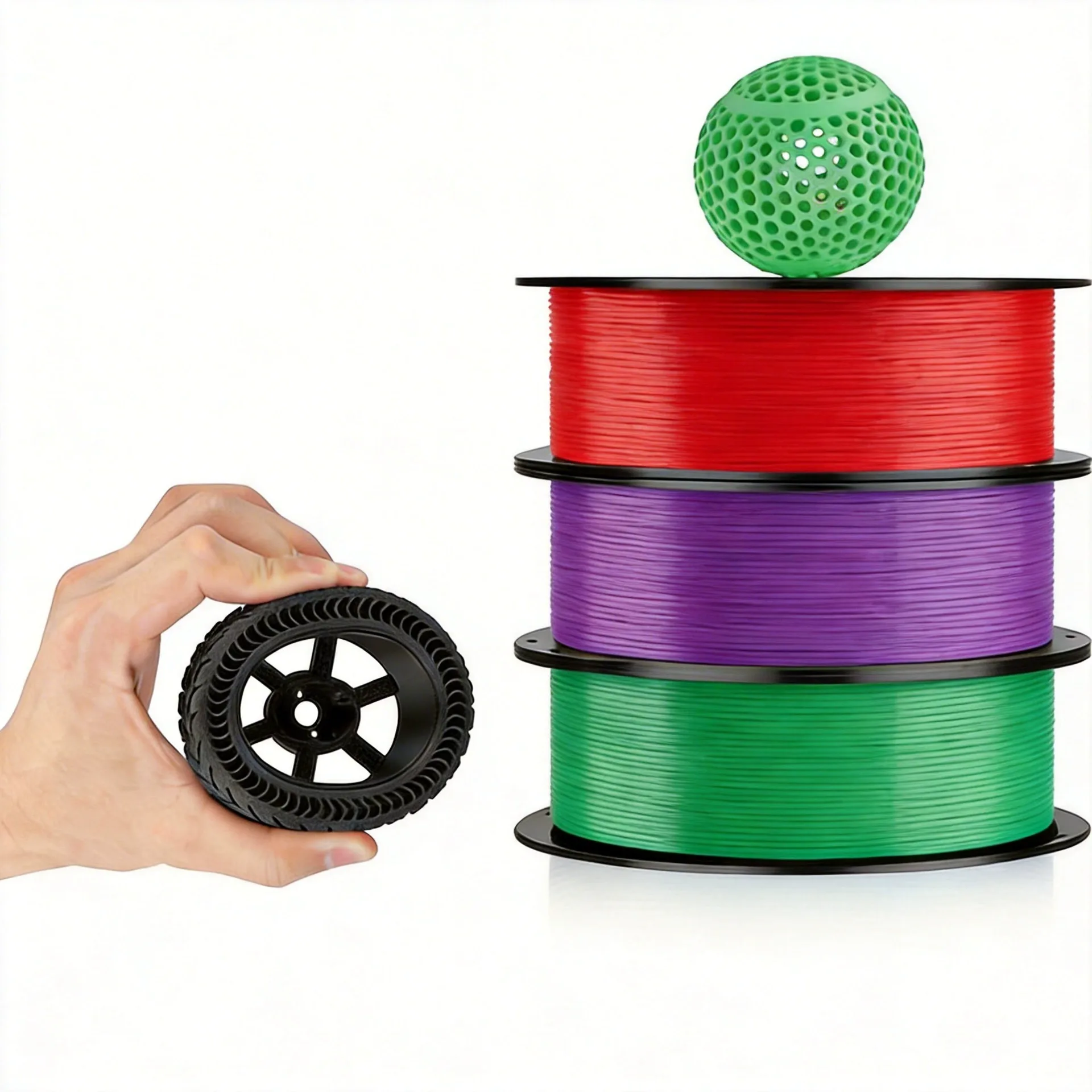
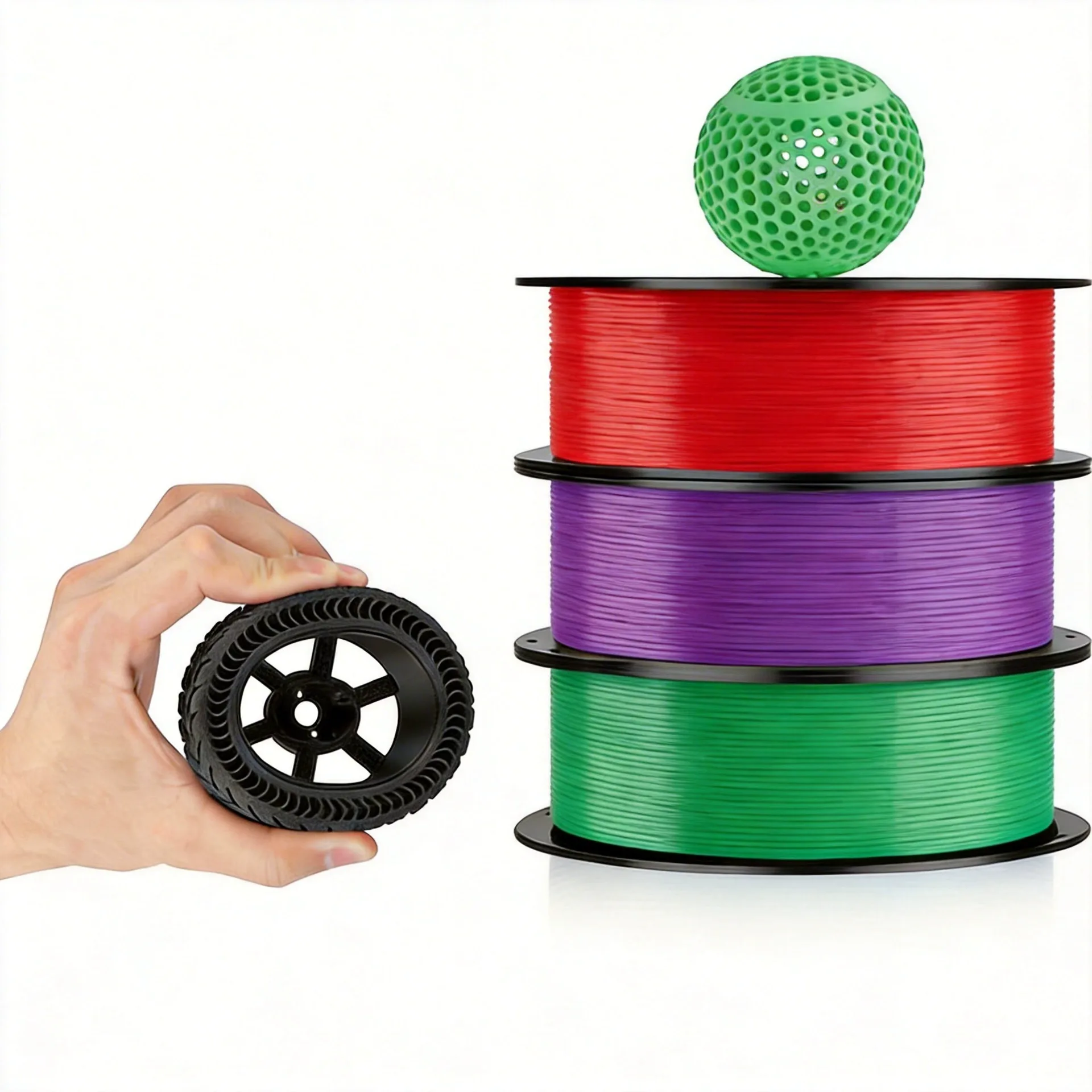
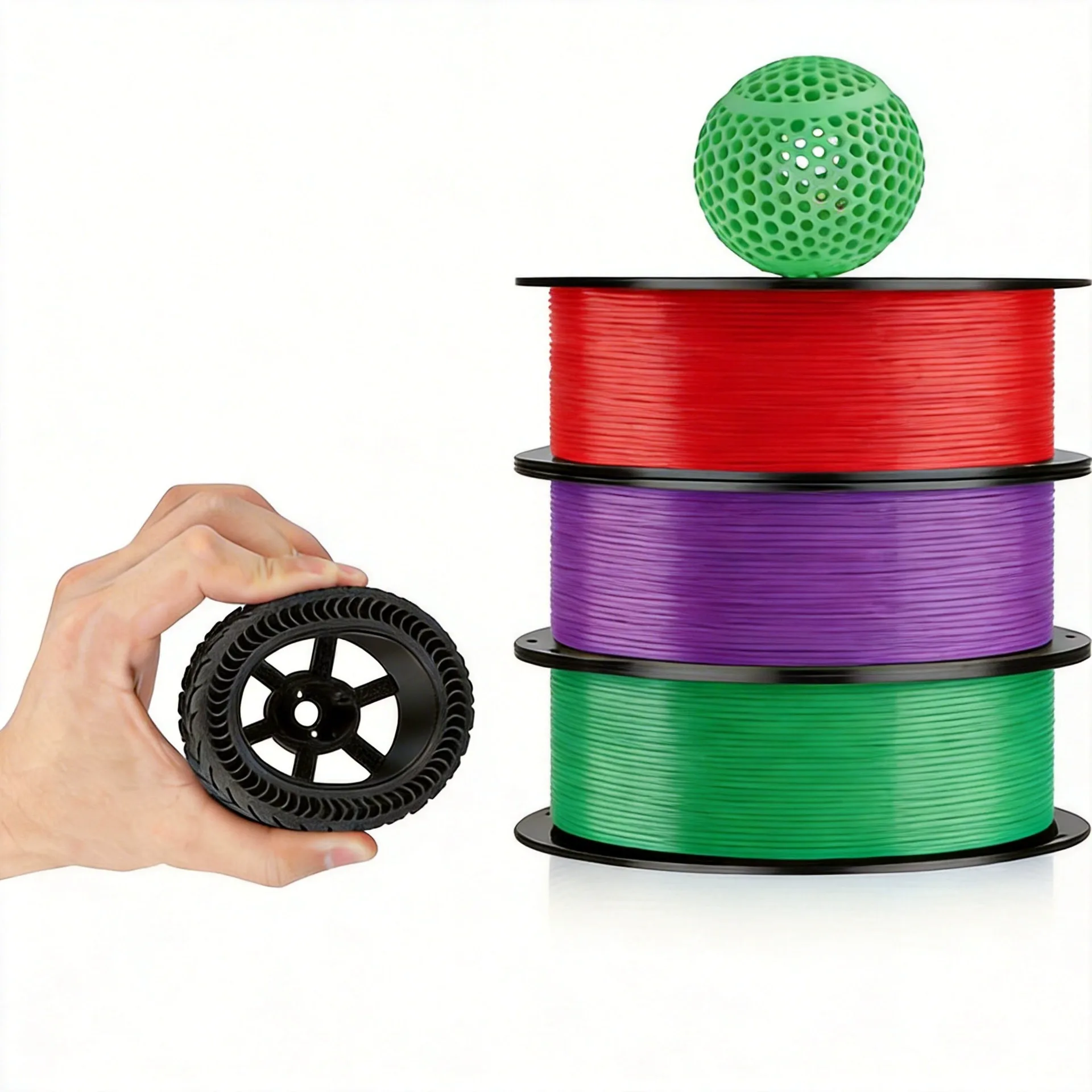
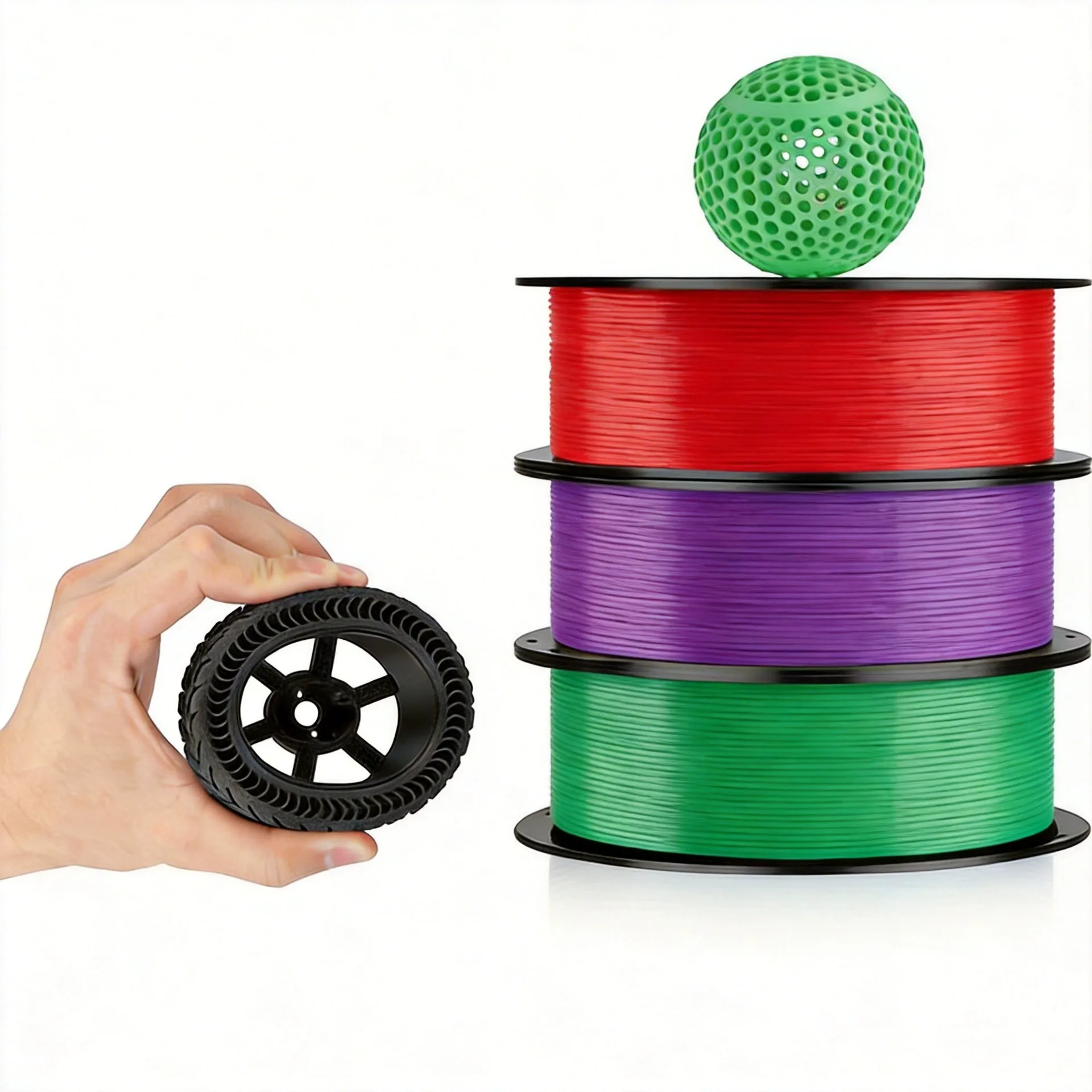
TPU Filament Black 1.75mm 1kg Yiqiu3D Flexible

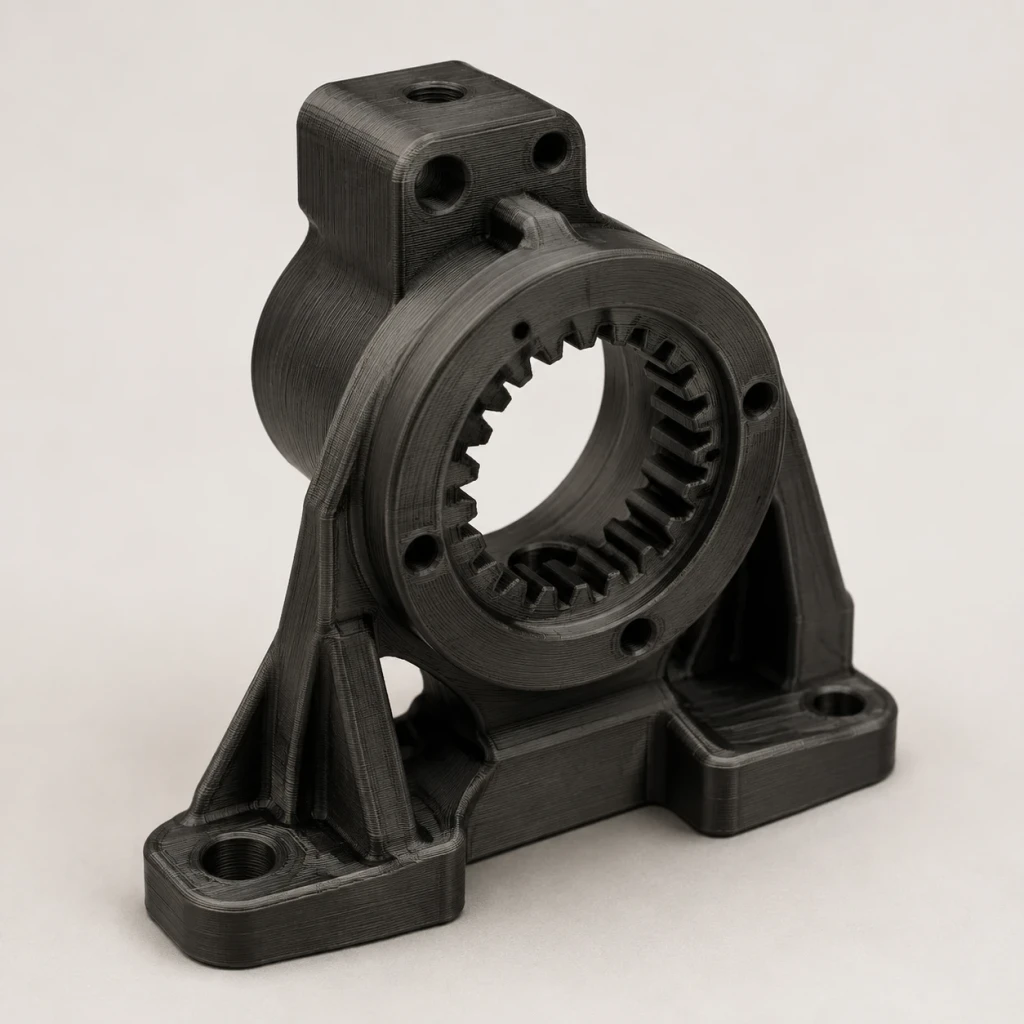
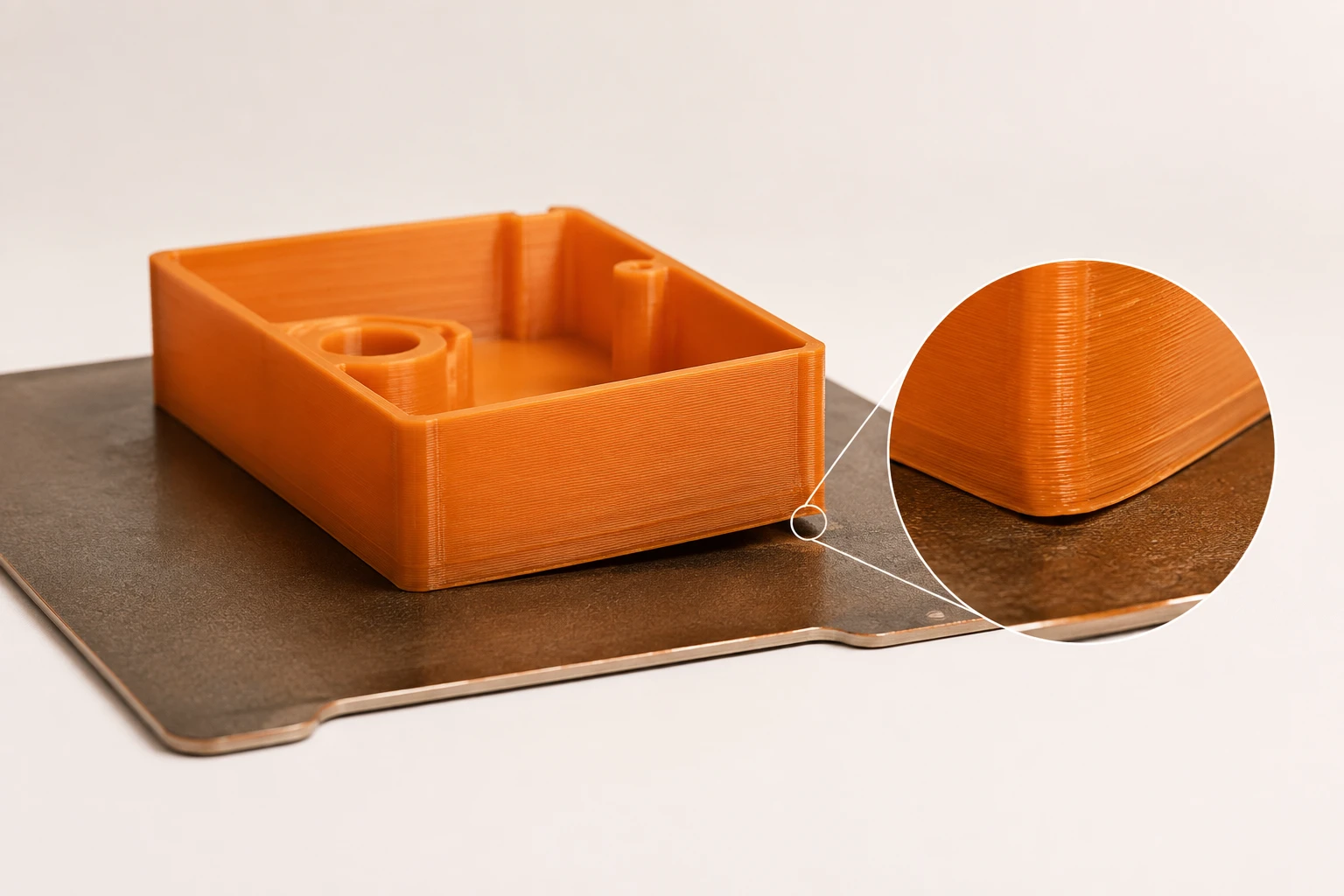
Brand: Yiqiu3D · Model: TPU 1.75mm 1kg · Rigid filament fails at the joint: a bracket that should give snaps, a gasket that should seal leaks. This TPU bends, stretches and springs back, and shrugs off abrasion, so hose seals, grips, bumpers, cable strain reliefs and vibration dampers keep working instead of being replaced. It stays flexible in cold service, where hard polymers go brittle. The strand is round-profile 1.75 mm, which matters on a soft grade: oval or flattened filament starves the nozzle and leaves gaps in the wall.

  • Nine references are stocked: Black
  • Recorded parameters for your catalogue: 1.75 mm diameter
  • take the exact value from your own TPU profile.
Compare filaments
Diameter 1.75mm
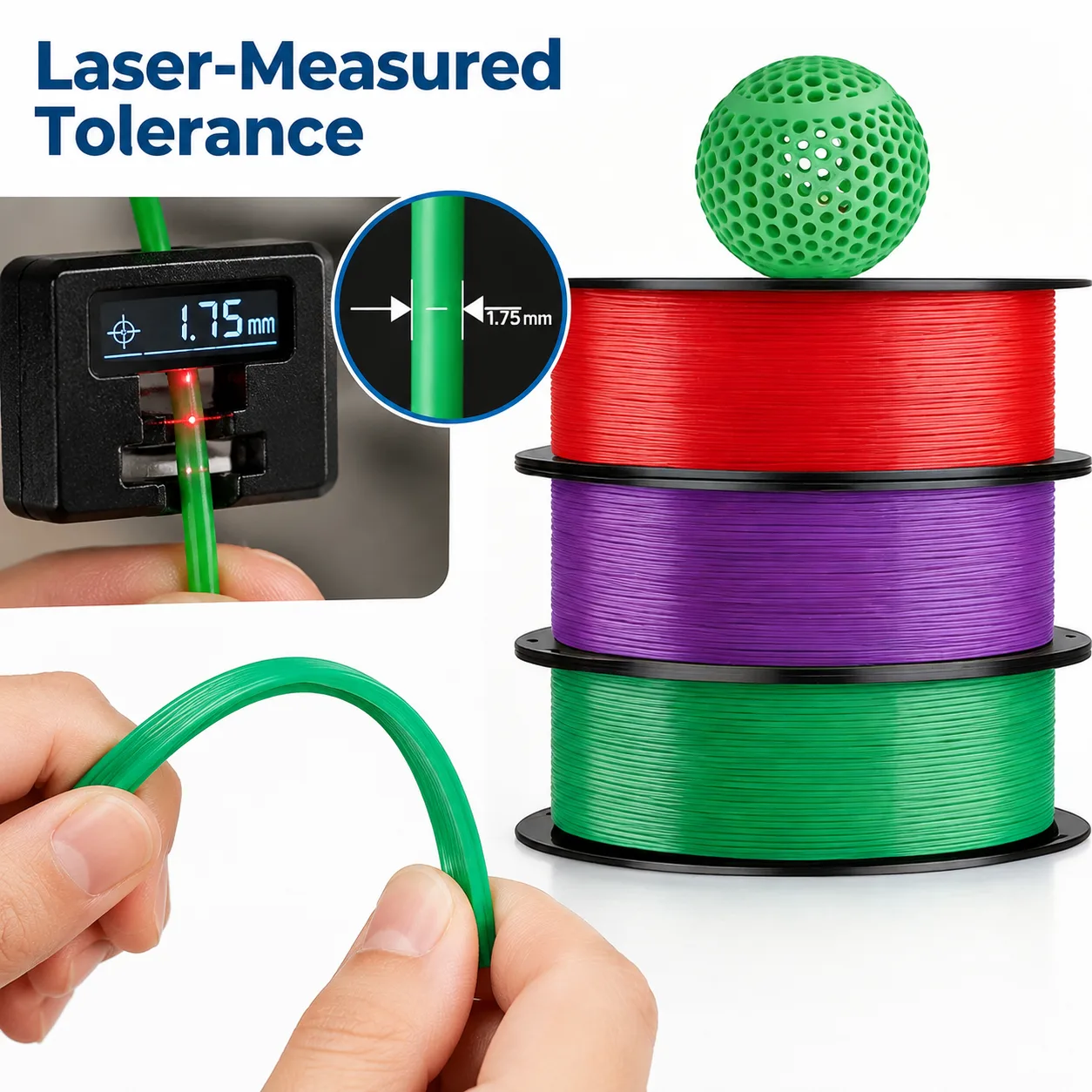
Tolerance ±0.03mm
Material TPU
Quick Answer

What makes TPU different from rigid filament such as PLA or PETG?

TPU is a flexible polyurethane. The printed part bends, stretches and springs back instead of cracking, and it stands up to abrasion and repeated flexing that would break a stiff polymer, while keeping that flexibility in cold service. Choose it for parts that must absorb shock, seal, grip or damp vibration. It is not a structural grade: if the part has to be stiff and dimensionally rigid, use ABS or a carbon-fibre ABS and keep TPU for the interfaces that move.

Full answers below
Is it right for my project?

Best for: For parts that must bend and recover: wearables, grips and protective bumpers - available in 9 colours; lead colour Black per spool. Not ideal for: Avoid on direct-drive-less setups at high speed - flexible filament needs a suitable extruder - available in 9 colours; lead colour Black per spool.

Print settings

Nozzle 220°C

01 · Why this one

Product highlights

4 reasons

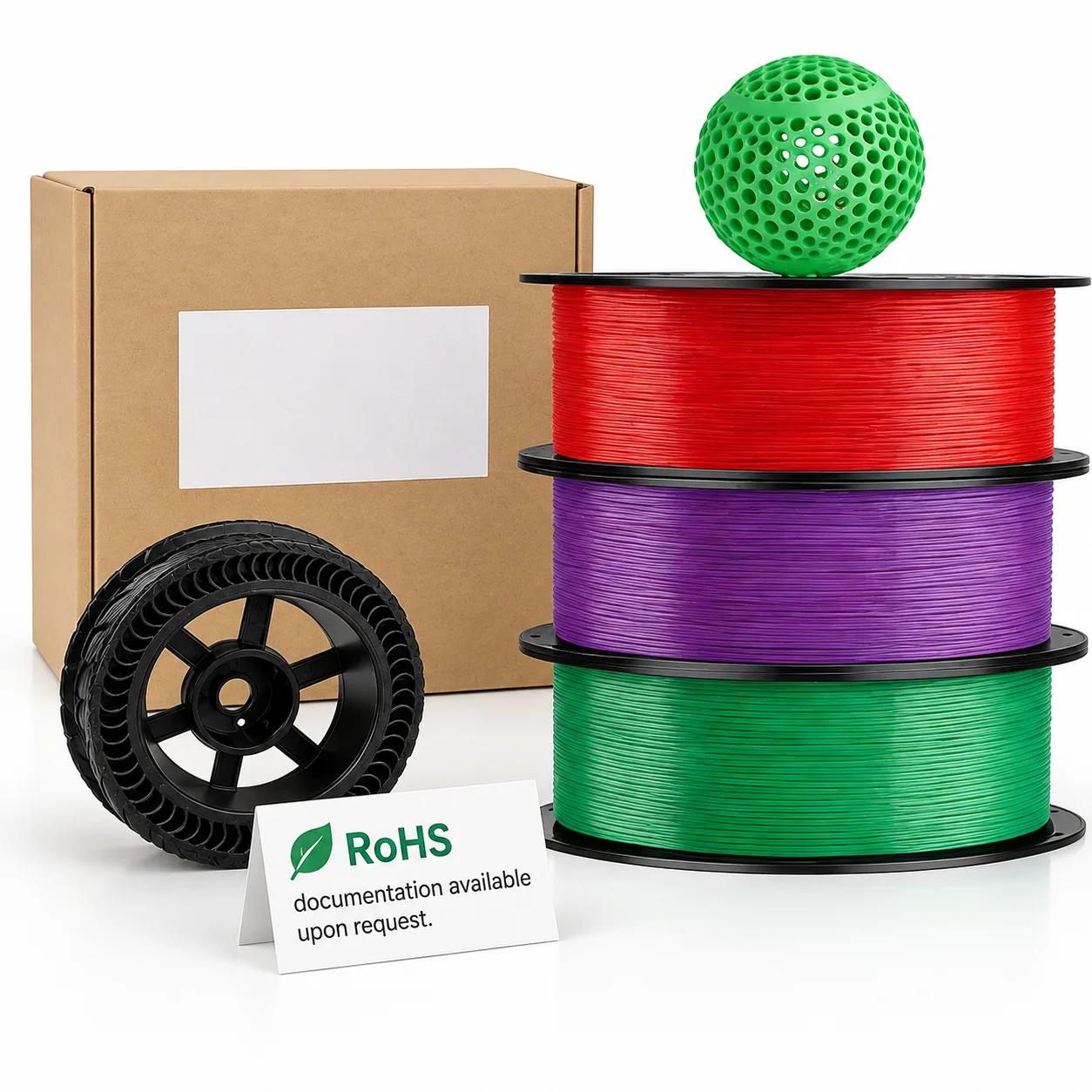
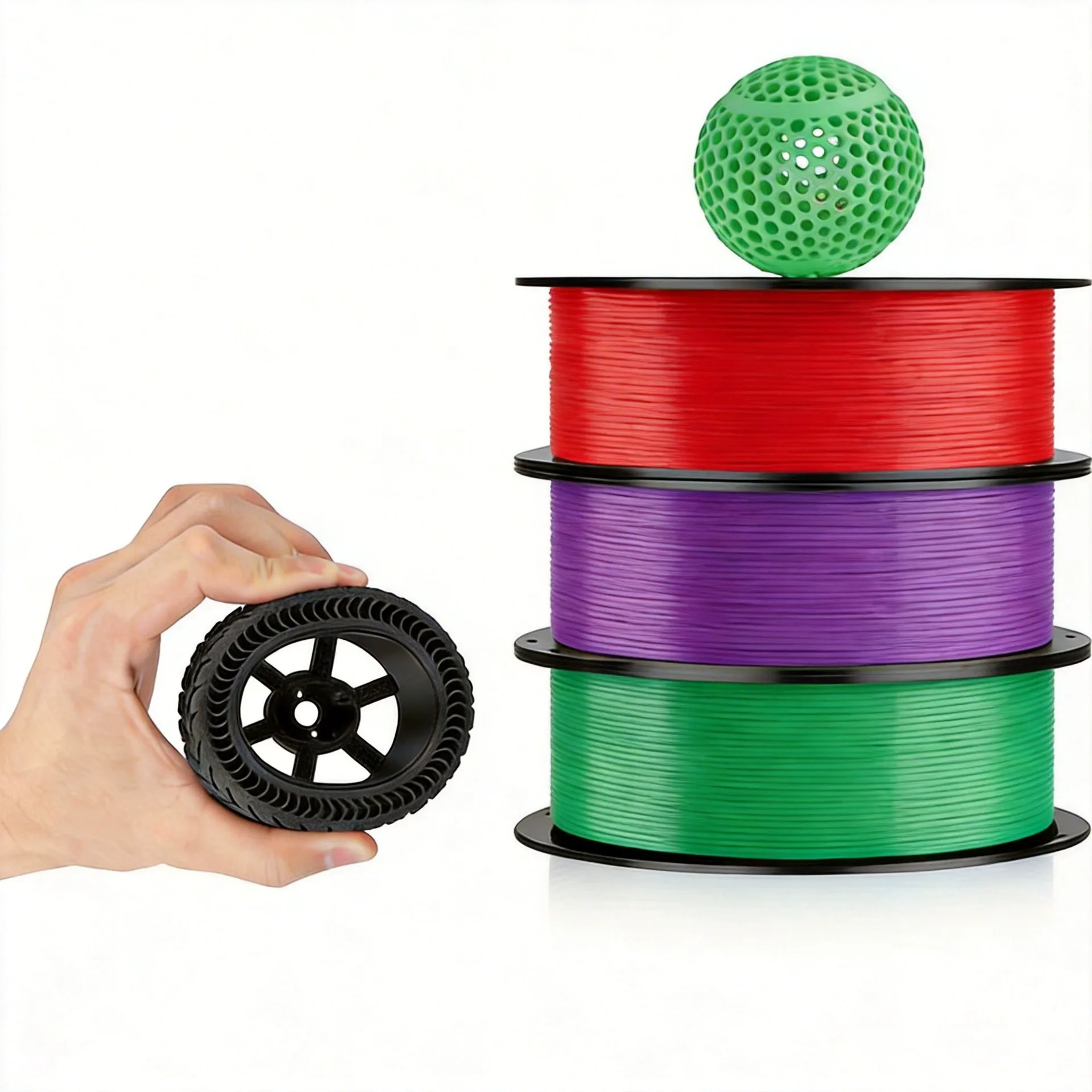
Nine references are stocked: Black, the lead colour, plus White, Red, Silver, Yellow, Green, Blue, Grey and Transparent, each supplied per spool. Pigment is compounded into the resin, so the colour runs through the part and does not rub off on the flexing surfaces. The colour name sits on the spool label, so a reorder is placed against the same reference, and mixed references ship as one consignment - a distributor can qualify the whole range on a single purchase order.

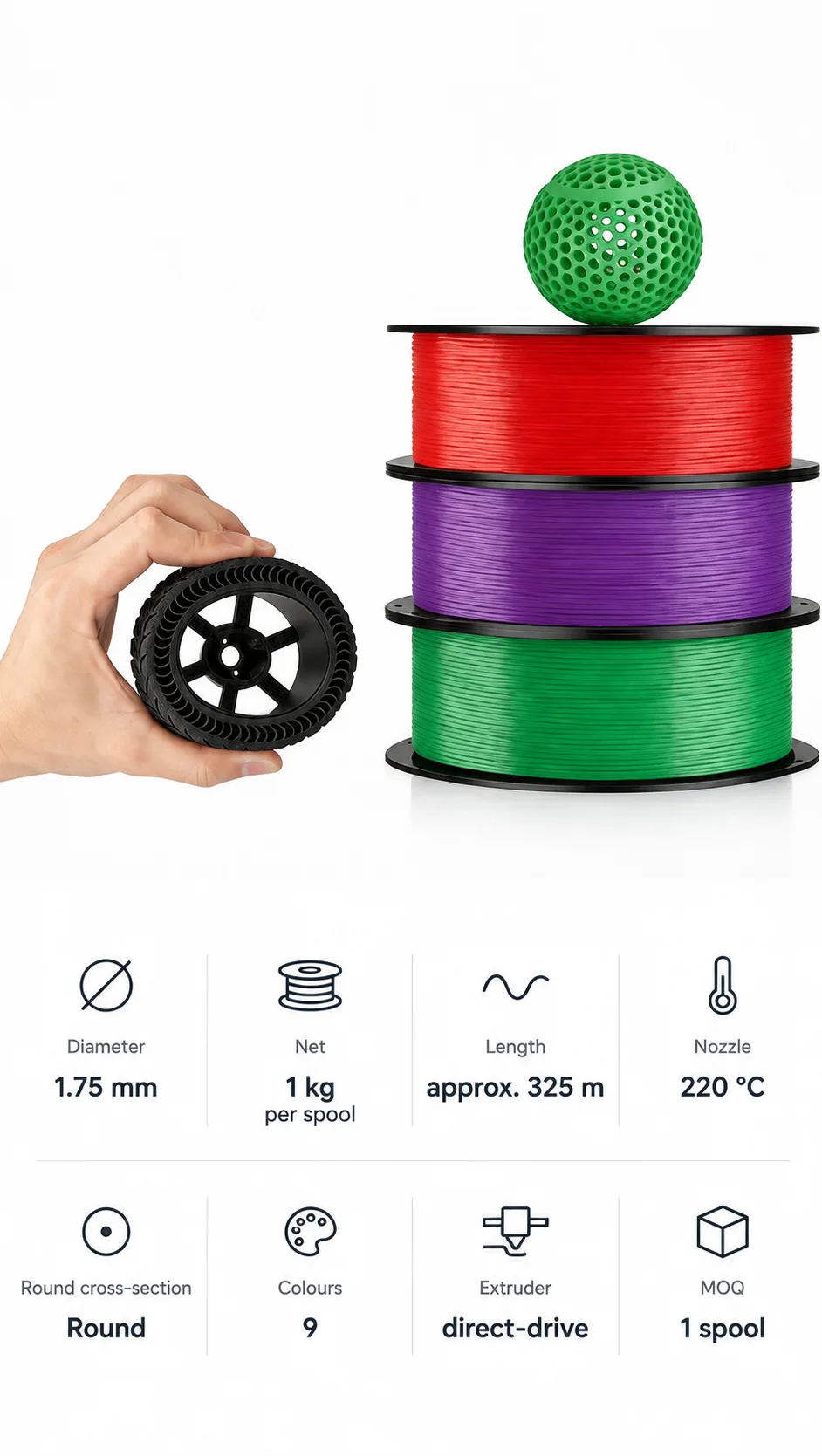
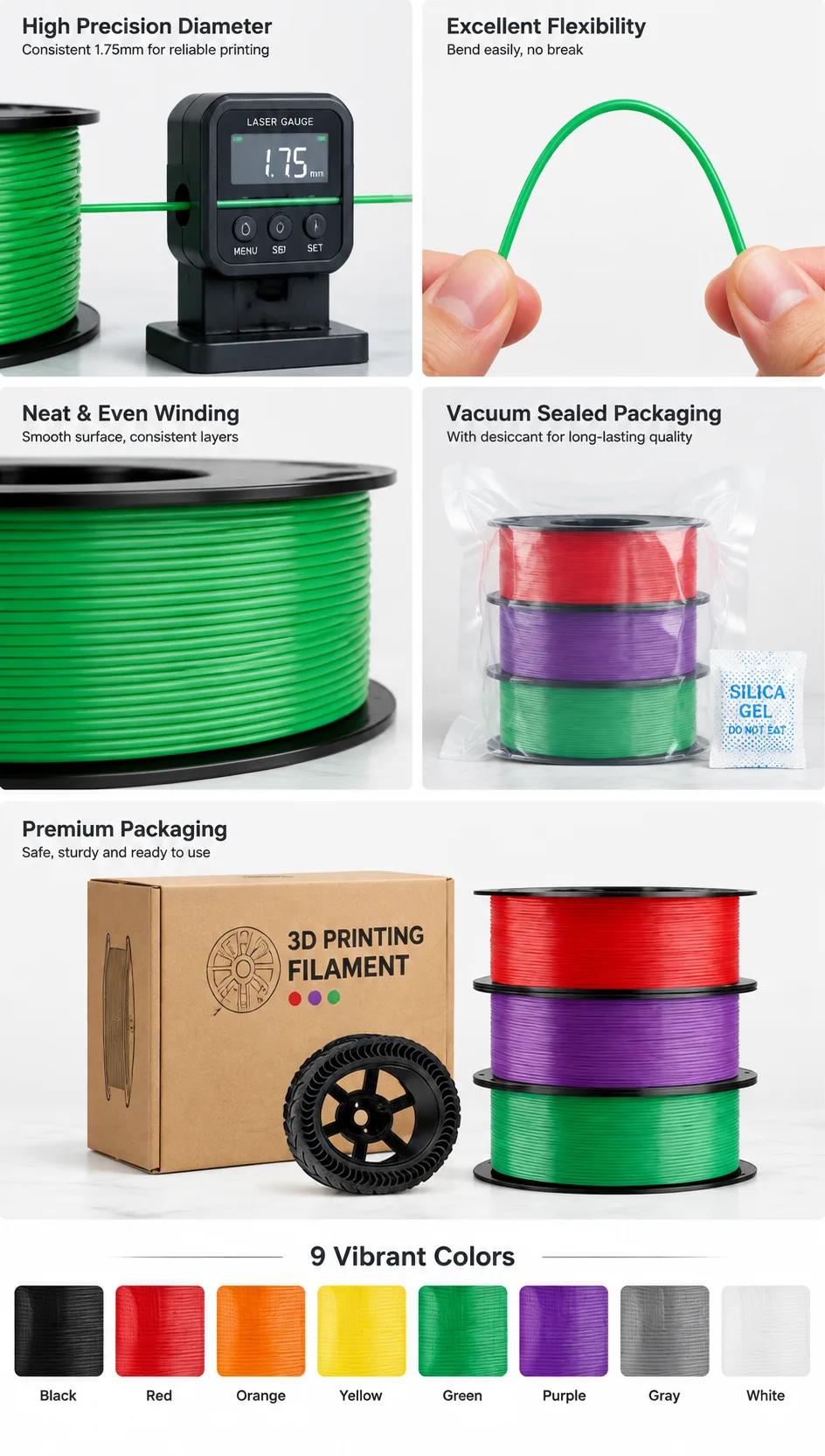
Recorded parameters for your catalogue: 1.75 mm diameter, round cross-section, 1 kg net filament per spool, approximately 325 m of strand, nozzle temperature, with the setting confirmed for your application. Tension-controlled winding and a consistent strand keep the feed even, which counts for more on a flexible grade than on a stiff one, because loosely wound TPU snags and stretches into thin spots mid-print. A heated bed is recommended

take the exact value from your own TPU profile.

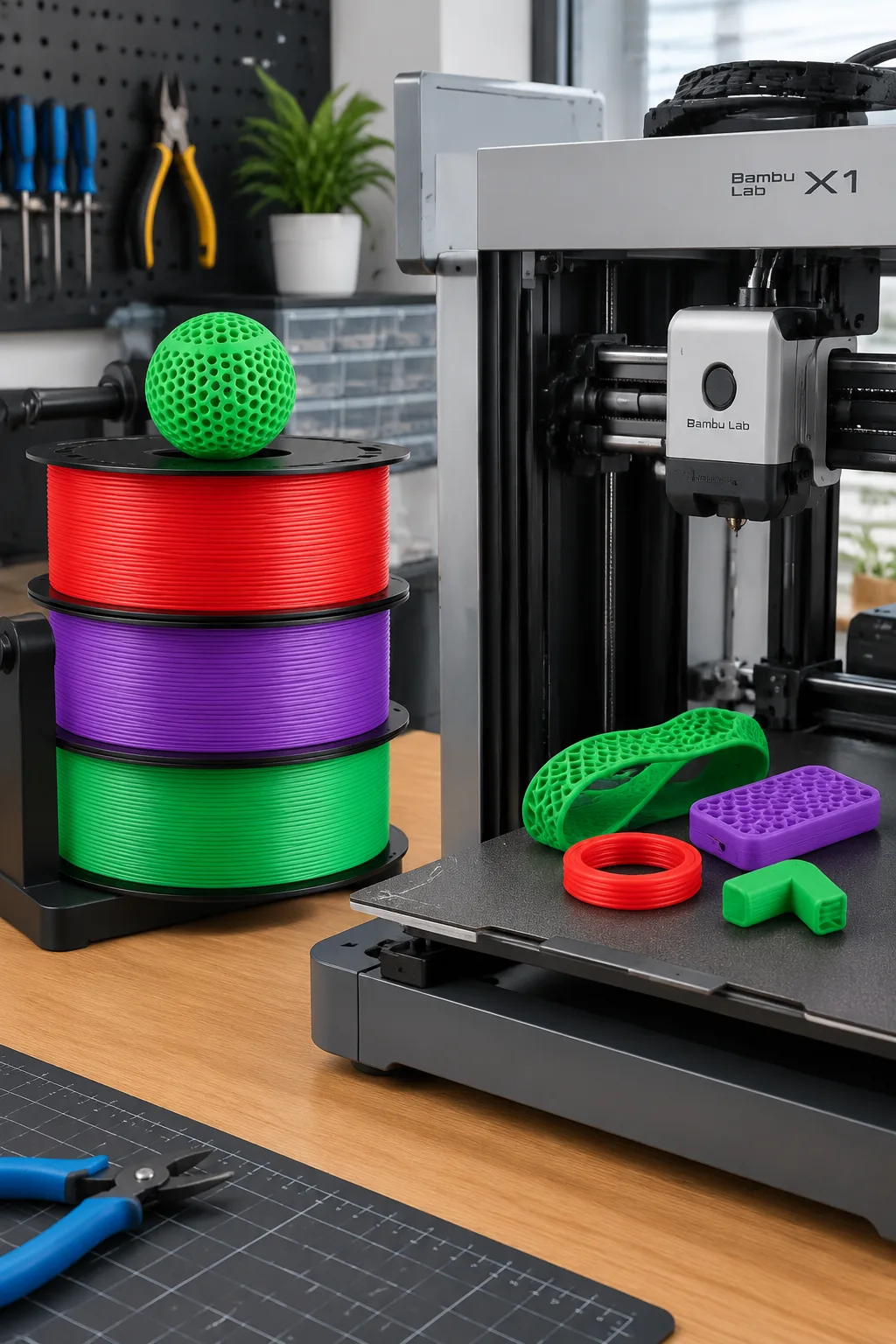
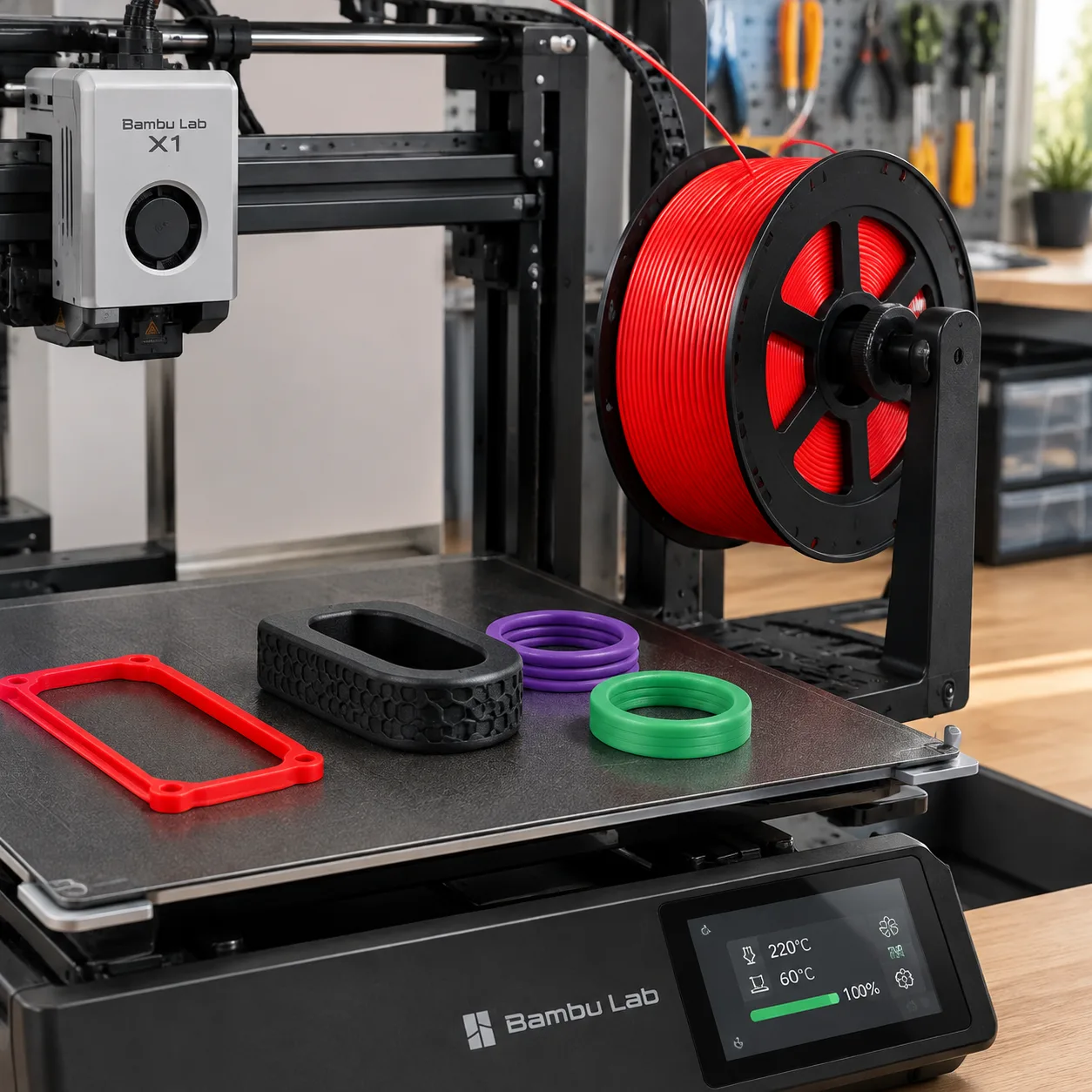
Flexible filament needs the right feed path: use a direct-drive extruder or a short Bowden setup, and print slowly. Push TPU through a long PTFE tube at PLA speed and the strand buckles at the drive gear and stretches at the nozzle. Keep retraction short, print at the confirmed setting with a moderate flow, and slow the outer walls down. On that profile it runs on standard 1.75 mm FDM machines including Bambu Lab, Creality, Prusa and Anycubic.

Technical Data

Specifications

Diameter 1.75mm
Tolerance ±0.03mm
Material TPU

Print Profile

TPU Filament Black 1.75mm 1kg Yiqiu3D Flexible prints best at 220°C nozzle.

Nozzle Temp220°C

Spool Specification

Spool details for your feeding and handling setup.

Gross Weight1.3 kg
Length325m
Spool Size (L×W×H)20.5 × 20.5 × 6 cm
Pack FormatPiece

Attributes

Country / Regionchina
HS Code39169010
Item No.tpu-black-flexible-wear-resistant-gaskets-bumpers
Product Name 3D Printer Consumables TPU
Grade TPU
Cross-Section Round
Item No. TPU
Application 3D Printer Consumables
Appearance Filament
Length 325m
Before You Ask

Frequently Asked Questions

What makes TPU different from rigid filament such as PLA or PETG?
TPU is a flexible polyurethane. The printed part bends, stretches and springs back instead of cracking, and it stands up to abrasion and repeated flexing that would break a stiff polymer, while keeping that flexibility in cold service. Choose it for parts that must absorb shock, seal, grip or damp vibration. It is not a structural grade: if the part has to be stiff and dimensionally rigid, use ABS or a carbon-fibre ABS and keep TPU for the interfaces that move.
Which printers does this filament run on?
Any FDM printer that uses 1.75 mm filament can run it, but the extruder decides the result: a direct-drive or short Bowden setup feeds TPU reliably, while a long PTFE tube lets the soft strand buckle. Bambu Lab, Creality, Prusa and Anycubic machines are all fine on the right profile. The spool is a standard round 1 kg format that fits common holders, and no enclosure or hardened nozzle is required. Send us your machine model and we will confirm the fit.
What print settings do you recommend?
Nozzle temperature confirmed for your application, the value recorded for this grade. Print slowly - roughly half your usual PLA speed - keep retraction short and use a moderate flow so the soft strand is not stretched. A 0.4 mm nozzle with 0.2 mm layers is a good starting point. Pair it with a heated bed and take the bed value from your own TPU profile, as this listing does not quote one.
How much filament is on one spool, and how far does it go?
Each spool carries 1 kg net of filament, which works out to approximately 325 m of 1.75 mm strand - enough for a batch of gaskets, grips or bumpers before a reorder. Quote the 1 kg net figure onward rather than any shipping weight, and note that the spool is a standard round format that fits common holders and multi-spool units.
Which colours are available, and can I order a mixed set?
Nine references are stocked: Black, the lead colour on this listing, plus White, Red, Silver, Yellow, Green, Blue, Grey and Transparent. Each reference is supplied per spool, so the reference name on the spool label is the colour code and per spool describes the supply format, not a shade. Mixed references can ship in one consignment, which is the practical way to test the range before a volume order.
What should I print with it?
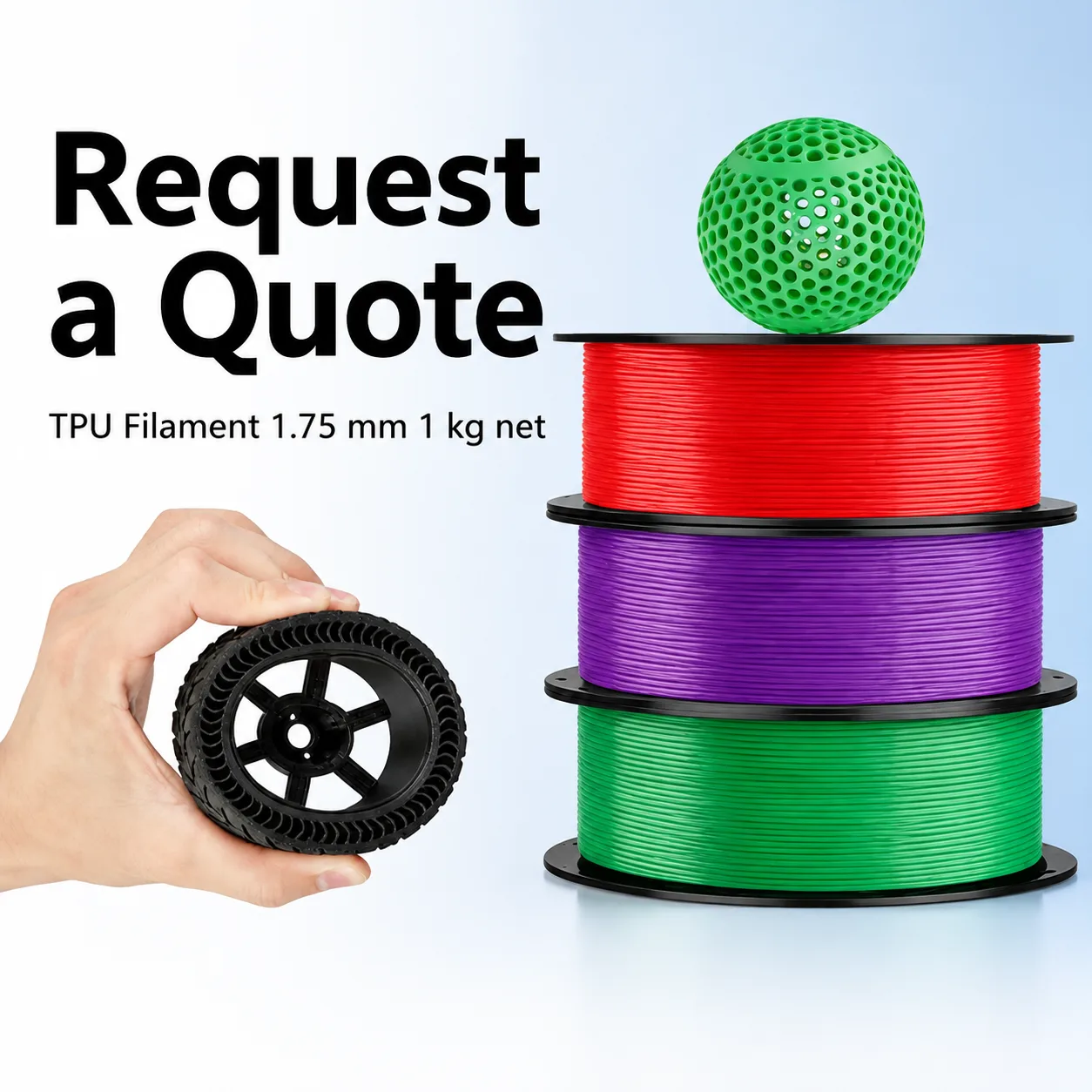
Parts that must bend and recover: gaskets and seals, phone and tool cases, grips and over-moulded handles, protective bumpers and corner guards, cable strain reliefs and flexible bushings, vibration dampers and machine feet, conveyor and machine guards, wearable straps and flexible hinges. Treat it as the flexible half of an assembly and pair it with a rigid grade where the part has to carry load.
How should the spool be stored?
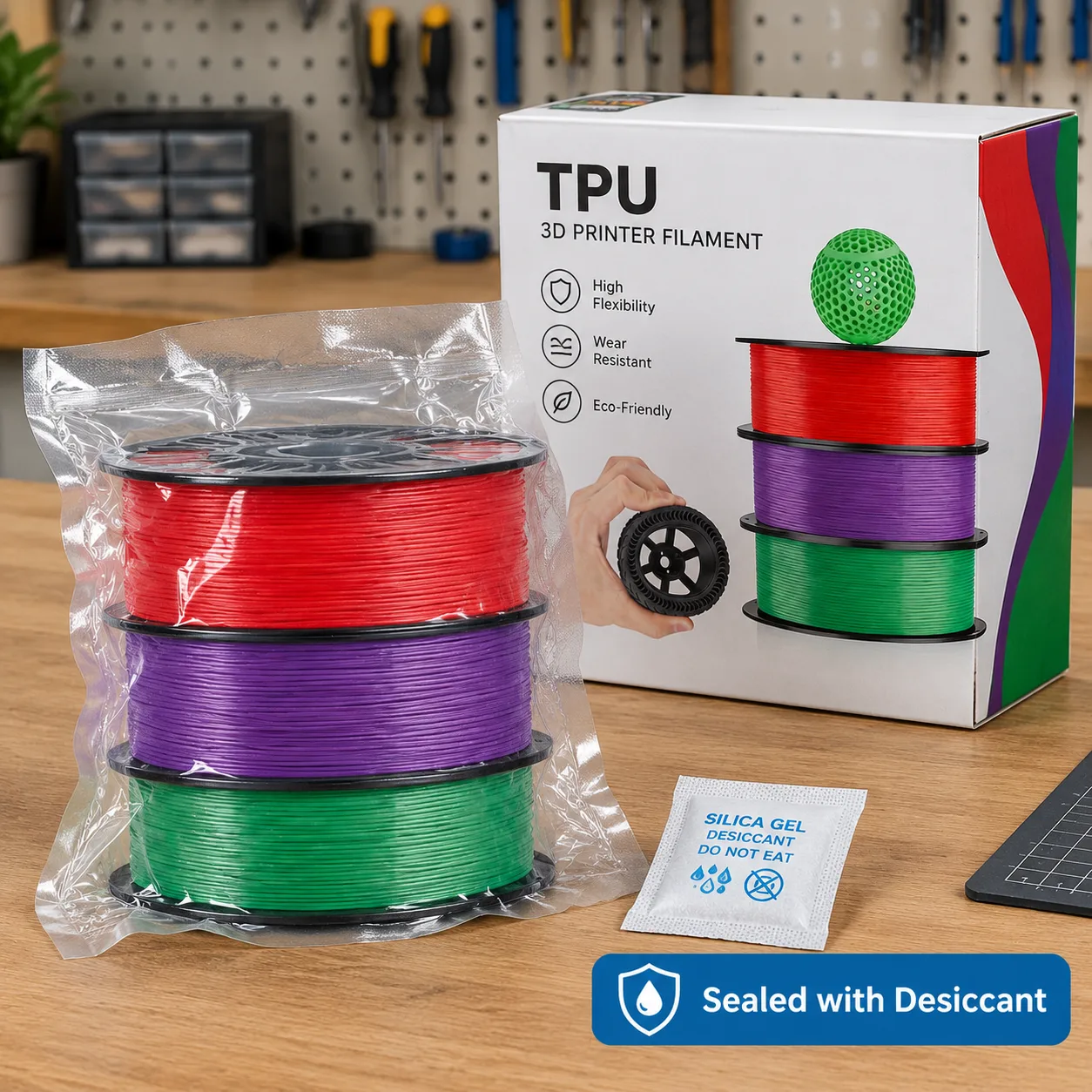
The spool ships vacuum sealed with a desiccant sachet inside the printed box. TPU is mildly hygroscopic, so reseal the spool between jobs or keep it in a dry cabinet: a dry roll is what keeps the extruded bead even and stops the popping and rough surface that wet flexible filament produces. Store it out of direct sunlight, and the winding holds its shape so the next job feeds just as cleanly.

Documentation & Downloads

Everything we publish for this material, in one place.

Ready to Order

Get factory-direct pricing on TPU Filament Black 1.75mm 1kg Yiqiu3D Flexible

Not sure this is the right material? → Compare filaments